
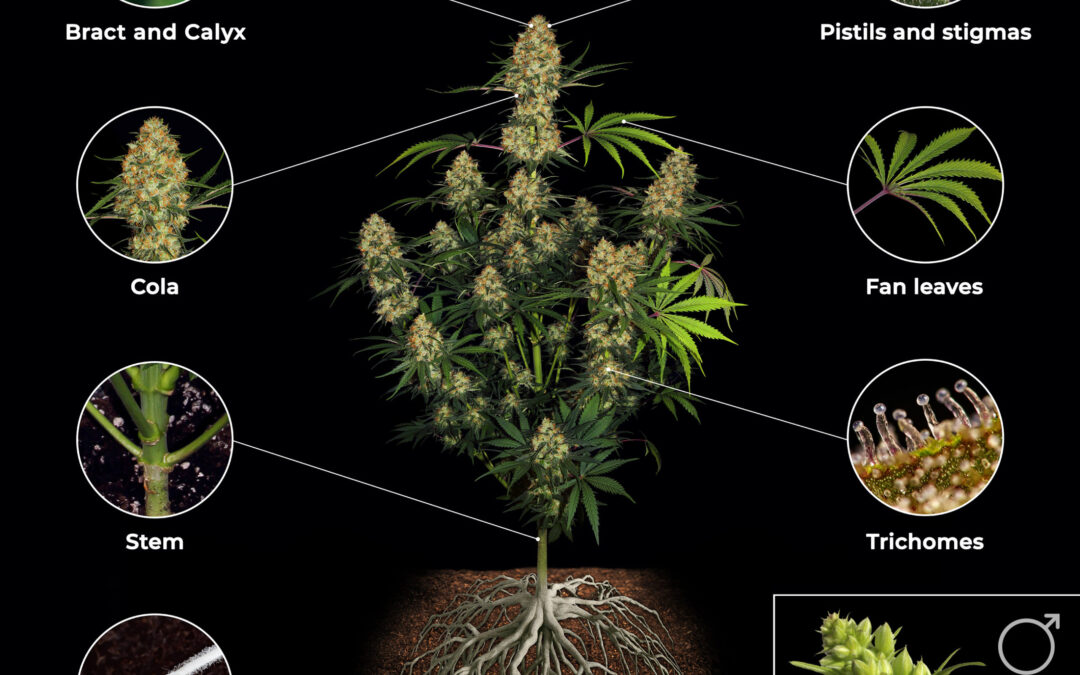
Cannabis flower anatomy can tell you a lot about what you are looking at when examining a cannabis bud. From the frosty trichomes covering the surface to the orange stigmas, bracts, calyxes and sugar leaves, every part of a cannabis flower has a specific role.
For consumers comparing THC flower, understanding these structures can also make product descriptions, cultivar information and laboratory data easier to understand.
This Sluggers Vapes guide explains the parts of a cannabis flower, what each structure does, how trichomes relate to cannabinoids and terpenes, and what to consider when evaluating cannabis flower.
Quick answer: The main visible components of a cannabis bud include trichomes, bracts, calyxes, stigmas, pistils, sugar leaves, colas and stems. Trichomes are especially important because they are resin-producing glands associated with cannabinoids and terpenes.
For a broader introduction to THC flower, visit our THCA for Beginners Guide to learn how THCA, THC, heating and cannabis flower relate to one another.
Cannabis Flower Anatomy at a Glance
A cannabis bud is more complex than it may appear.
The main structures you may encounter include:
- Trichomes – resin-producing glands associated with cannabinoids and terpenes
- Bracts – small protective structures surrounding reproductive components
- Calyx structures – small structures associated with the flower’s reproductive anatomy
- Pistils – female reproductive structures
- Stigmas – the hair-like strands that extend from the pistil
- Sugar leaves – small leaves growing around the flower
- Colas – clusters of cannabis flowers
- Stems – structural parts supporting branches and flowers
Different cannabis cultivars can have dramatically different appearances. Some produce dense, compact flowers while others produce more open buds. Colour, aroma, trichome coverage and structure can also vary according to genetics and growing conditions.
What Is Cannabis Flower?
Cannabis flower, commonly called bud, is the flowering portion of the cannabis plant.
Most consumer cannabis flower comes from female plants because their flowers develop the resin-rich structures associated with cannabinoids and terpenes. These flowers grow together in clusters commonly called colas.
Once harvested, cannabis flower is generally dried and prepared for sale as a finished product.
When shopping for THC flower, you may see descriptions referring to:
- Cultivar or strain
- THC or THCA content
- Terpene profile
- Flower weight
- Indoor or greenhouse cultivation
- Trim quality
- Trichome coverage
- Laboratory testing
Understanding the anatomy behind the flower makes these descriptions easier to interpret.
If you’re new to cannabis flower terminology, our THC Flower Guide is a useful next step.
1. Cannabis Trichomes
Trichomes are among the most important structures to understand when looking at cannabis flower.
They are tiny resin-producing glands found across cannabis flowers and other parts of the plant. Trichomes are associated with the production and storage of cannabinoids, terpenes and other plant compounds.
They are responsible for much of the familiar frosty, crystalline appearance of cannabis buds.
What Do Trichomes Look Like?
Under magnification, trichomes can look like tiny mushrooms.
The three commonly discussed types are:
- Bulbous trichomes
- Capitate-sessile trichomes
- Capitate-stalked trichomes
Capitate-stalked trichomes are particularly prominent on cannabis flowers and can be visible without a microscope.
Why Are Trichomes Important?
Trichomes are closely associated with the cannabinoids and terpenes that contribute to the chemical and aromatic characteristics of cannabis flower.
However, more visible trichomes should not automatically be interpreted as proof that a flower is better.
Genetics, cultivation, harvesting, drying, curing, storage and laboratory results can all influence the finished product.
This is why visual appearance should be considered alongside cannabinoid and terpene information.
For more information, see our Cannabis Lab Testing & COA Guide.
2. Bracts
Bracts are small structures surrounding the reproductive components of the cannabis flower.
They can look like tiny green, tear-shaped leaves and can carry a significant concentration of trichomes.
When you look closely at a cannabis bud, the overlapping bracts contribute significantly to the dense structure of the flower.
Because they can be heavily covered in trichomes, bracts are one reason the surface of a cannabis bud can appear particularly resinous.
Bracts vs Leaves
Bracts should not simply be confused with ordinary cannabis fan leaves.
Fan leaves are much larger and primarily serve the plant’s photosynthetic needs, while bracts are closely associated with the reproductive structures of the flower.
3. Calyxes and Cannabis Flower Anatomy
The calyx is one of the more confusing terms in cannabis anatomy.
Cannabis terminology varies between botanical descriptions and grower terminology, and bracts and calyxes are sometimes incorrectly used interchangeably.
In cannabis flowers, calyx-related structures are located within the flower and are difficult to identify individually without magnification.
For consumers, the important point is that these structures form part of the reproductive anatomy hidden within the visible bud.
If you are reading detailed cannabis cultivation or botanical information, understanding the difference between bracts and calyx structures can prevent confusion.
4. Pistils and Stigmas
Those familiar orange, red, yellow or white hairs extending from a cannabis bud are commonly called pistils.
Technically, the hair-like strands themselves are called stigmas, while the pistil is the larger female reproductive structure containing them.
Stigmas can change colour as a flower develops.
You may see:
- White
- Cream
- Yellow
- Orange
- Red
- Brown
Do Orange Hairs Mean Better Cannabis?
Not necessarily.
Stigma colour is one visual characteristic of a cannabis flower, but it should not be treated as a standalone measurement of quality, cannabinoid content or overall product value.
When comparing flower, it is better to consider the complete picture:
Appearance + cannabinoid information + terpene profile + laboratory information + storage and handling.
5. Sugar Leaves
Sugar leaves are the small leaves that grow around cannabis flowers.
They are called “sugar leaves” because they can become heavily coated with visible trichomes, giving them a frosty appearance.
Sugar leaves are different from the large fan leaves found elsewhere on the cannabis plant.
Because sugar leaves can contain trichomes, some may remain attached to harvested flower while others are removed during trimming.
Is Sugar Leaf on Cannabis Flower Bad?
Not necessarily.
A small amount of sugar leaf material can naturally remain after trimming.
The more important consideration is the overall presentation and the quality of the finished flower rather than whether every individual piece has been trimmed to an identical appearance.
6. Cannabis Colas
A cola refers to a cluster of cannabis flowers growing together.
The main cola develops toward the top of the plant, while additional smaller colas can form along branches.
After harvesting and processing, consumers generally see individual buds rather than an entire cola.
The size and shape of a cola can vary depending on:
- Genetics
- Cultivation method
- Plant structure
- Growing conditions
- Training techniques
A larger cola does not automatically mean a higher-quality finished product.
7. Cannabis Flower Stems
Stems provide structural support for cannabis branches and flowers.
Small stems can remain attached to harvested buds, especially when flower is separated from larger branches.
When purchasing flower by weight, consumers should pay attention to the stated product weight and overall presentation rather than judging quality purely by bud size.
Cannabis Flower Anatomy and Trichome Coverage
One of the first things many consumers notice when looking at cannabis flower is trichome coverage.
A heavily frosted flower can have an obvious crystalline appearance, but visual trichome coverage should not be treated as a complete quality assessment.
Trichome production is influenced by genetics and environmental factors, while excessive exposure to heat, oxygen, light and time can contribute to degradation.
This makes post-harvest handling and storage important considerations as well.
If you want to learn more about keeping flower in good condition, see our How to Store Cannabis Flower guide.
Cannabis Flower Anatomy and Terpenes
Trichomes are also closely connected to the terpene profile of cannabis flower.
Terpenes are aromatic compounds that contribute to the smell and flavour characteristics associated with different cultivars.
Depending on the cultivar, cannabis flower may have aromas described as:
- Citrus
- Berry
- Tropical
- Floral
- Earthy
- Pine
- Herbal
- Spicy
This is why two cannabis flowers with similar visual characteristics can still have noticeably different aromas.
When comparing flower products, looking at the terpene profile alongside cannabinoid information can provide more useful information than relying only on the colour or density of the bud.
For readers wanting to understand common cannabis classifications, our Indica vs Sativa vs Hybrid Guide explains why these labels should be considered alongside the individual cultivar and its chemical profile.
How Cannabis Flower Anatomy Can Help You Evaluate Flower
Understanding the physical structure of cannabis flower can help you become more familiar with product descriptions.
However, there is an important distinction between identifying flower characteristics and proving product quality.
Here are several things worth considering.
1. Look at the Overall Appearance
Healthy-looking cannabis flower can vary significantly in colour, density and structure.
Do not assume that one particular appearance represents every quality flower.
2. Examine Trichome Coverage
Visible trichomes can contribute to the frosty appearance associated with many cultivars.
But visual trichome coverage alone does not provide a complete picture of cannabinoid or terpene content.
3. Consider Aroma
A distinct aroma can provide clues about the flower’s terpene profile.
A strong or unusual smell should not automatically be interpreted as proof of higher quality either.
4. Check Cannabinoid Information
Where available, review the stated cannabinoid information.
For products containing THCA, it is also useful to understand the difference between THCA and THC and how heat affects cannabinoids.
Our THCA vs THC Guide explains the distinction in greater detail.
5. Review Laboratory Information
Laboratory testing can provide information that cannot be established simply by looking at a cannabis bud.
Depending on the product and test, a COA may provide cannabinoid and other analytical information.
This makes laboratory documentation a useful part of evaluating cannabis products.
Cannabis Flower Appearance vs Actual Product Information
It can be tempting to judge cannabis flower entirely by appearance.
A large, dense and frosty bud may look appealing, but appearance alone cannot tell you everything about the product.
For example, you cannot reliably determine from appearance alone:
- Exact cannabinoid concentration
- Complete terpene composition
- Whether laboratory testing has been performed
- How the flower was stored
- How old the product is
- Whether the stated cannabinoid information is accurate
That is why consumers should combine visual inspection with available product information.
For U.S. consumers comparing cannabis products, our Cannabis Comparisons content provides additional information for comparing different product categories and cannabinoid profiles.
Common Cannabis Flower Anatomy Questions
What are the crystals on cannabis buds?
The crystal-like structures are primarily trichomes. They are resin-producing glands associated with cannabinoids, terpenes and other compounds found in cannabis.
What are the orange hairs on cannabis?
The orange or reddish hairs are stigmas, which are part of the pistil, the female reproductive structure of the flower.
What is a cannabis bract?
A bract is a small protective structure associated with the female cannabis flower. Bracts can be heavily covered in trichomes.
What are sugar leaves?
Sugar leaves are small leaves that grow around cannabis flowers and can carry substantial numbers of trichomes.
What is a cannabis cola?
A cola is a cluster of cannabis flowers growing together on a plant. The main cola typically develops toward the top of the plant.
Do more trichomes mean better cannabis?
Not automatically. Trichome coverage is an interesting visual characteristic, but overall product quality involves genetics, cultivation, post-harvest handling, cannabinoid and terpene information, storage and laboratory testing.
What is the difference between a pistil and a stigma?
The pistil is the female reproductive structure, while the visible hair-like stigmas form part of that structure.
Final Thoughts on Cannabis Flower Anatomy
Understanding cannabis flower anatomy gives you a better way to interpret what you see when examining cannabis buds.
The frosty trichomes, resin-covered bracts, stigmas, sugar leaves and overall flower structure all contribute to the appearance of cannabis.
But visual characteristics are only one part of evaluating a product.
For a more complete assessment, consider the cultivar, cannabinoid profile, terpene information, laboratory documentation, packaging and storage conditions alongside the physical appearance of the flower.
If you’re researching THC and cannabis flower before choosing a product, start with our THCA for Beginners Guide and then explore our THC Flower Guide for a broader overview.
When you’re ready to compare available products, you can also explore the THC Flower collection at Sluggers Vape.